IACS Engineering helps manufacturers, utilities and industrial operators connect existing plant data systems to AI assistants such as ChatGPT, Claude or private LLMs using read-only APIs, controlled middleware and secure OT/IT integration design.
This service helps engineering and operations teams ask better questions of plant data using natural language — without giving AI direct control of PLCs, SCADA systems or critical equipment.
What We Help You Build
We design practical AI access layers for industrial data systems, including:
- AVEVA PI / OSIsoft PI historian access using PI Web API, read-only service accounts, restricted endpoints or proxy layers
- Ignition SCADA integration via SQL, MQTT, REST APIs, scripting interfaces, reporting databases or MCP-style tools where appropriate
- Read-only access to SQL databases, alarm records, production data and historian trends
- Controlled tool interfaces for ChatGPT, Claude or private AI assistants
- AI-assisted shift summaries, alarm summaries, downtime reports and root-cause investigation support
- Secure proof-of-concept systems before any production deployment
The objective is not to “connect AI to the plant.”
The objective is to create a controlled, auditable and read-only pathway between industrial data and AI-assisted insight.
Typical Use Cases
Natural-Language Historian Queries
Engineers may ask questions such as:
- “Show the pump vibration trend before the last trip.”
- “Compare yesterday’s flow rate with the same shift last week.”
- “Summarise high-priority alarms during the night shift.”
- “Which process variables changed before the temperature excursion?”
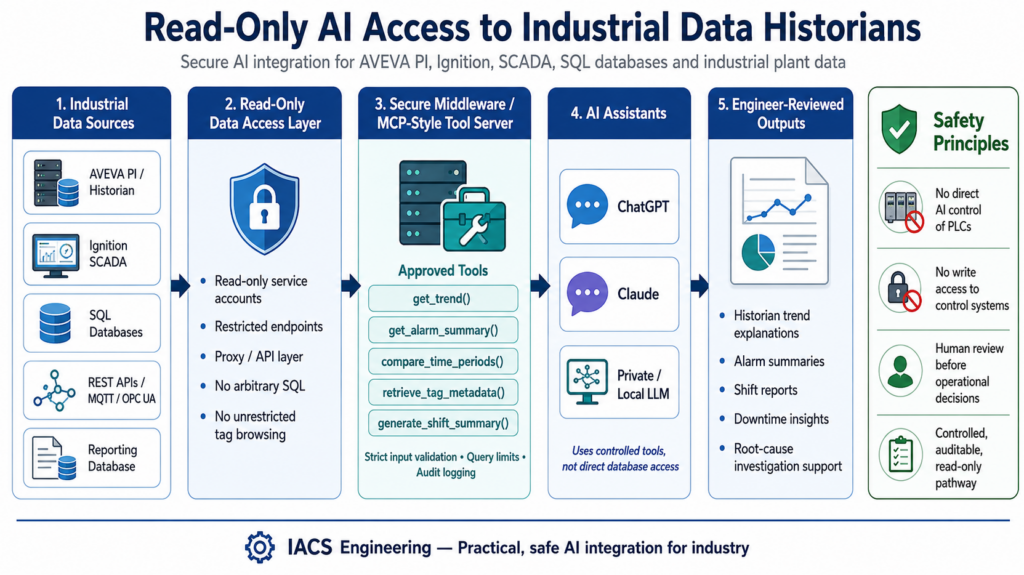
The AI assistant does not receive unrestricted historian or database access. Instead, it calls approved tools such as:
get_trend()
get_alarm_summary()
compare_time_periods()
retrieve_tag_metadata()
generate_shift_summary()
Each tool has defined inputs, outputs, limits and access controls.
Why Read-Only AI Access Matters
In industrial automation, safety and reliability come first.
For early-stage AI adoption, the safest approach is usually:
- No direct AI control of PLCs
- No write access to SCADA or control systems
- No arbitrary SQL access
- No unrestricted tag browsing
- Read-only service accounts
- Restricted APIs or proxy layers
- Query logging and audit trails
- Human review before operational decisions
This allows organisations to explore AI value while protecting control-system integrity.
MCP and Industrial AI Tooling
Model Context Protocol, or MCP, is a structured way to connect AI assistants to external tools, data sources and APIs.
For industrial environments, MCP-style design can expose only approved functions to the AI assistant, such as querying historian data, summarising alarms or generating reports.
MCP is not a direct database connection. It is a controlled tool layer.
A good industrial MCP or API design should include:
- Strict input validation
- Read-only permissions
- Query limits
- Tag access control
- Rate limiting
- Audit logging
- Human approval for operational decisions
This helps prevent unsafe AI behaviour and keeps engineering control at the centre of the system.
Example Architecture
Historian / SCADA / SQL / Reporting Database
        ↓
Read-Only API or Data Access Layer
        ↓
Secure Middleware / MCP-Style Tool Server
        ↓
ChatGPT, Claude or Private AI Assistant
        ↓
Engineer-Reviewed Insights and Reports
The system can be deployed locally, cloud-based or hybrid depending on cybersecurity and business requirements.
If cloud AI tools are used, data exposure, privacy, contractual controls and cybersecurity requirements should be reviewed before production use.
Systems We Can Work With
IACS Engineering can assist with industrial AI integration involving:
- AVEVA PI / OSIsoft PI
- Ignition SCADA
- SQL databases
- REST APIs
- MQTT
- OPC UA
- Historian interfaces
- Reporting databases
- Edge gateways
- Python automation
- ChatGPT Actions
- Claude MCP
- Private or local LLMs
Where protocols such as Modbus TCP or DNP3 are involved, access should normally occur through an approved SCADA layer, historian, gateway or replicated dataset — not direct AI access to live control devices.
Suggested Starting Point
A practical first step is an AI Historian Integration Assessment.
This may include reviewing:
- Existing historian or SCADA platform
- Available APIs
- Tag structures
- Alarm and event data
- Reporting databases
- Cybersecurity constraints
- Network access boundaries
- Suitable read-only AI use cases
- Proof-of-concept roadmap
A typical proof of concept may start with one data source, 5–10 tags, and 3–5 controlled tools.
Who This Is For
This service is suitable for:
- Manufacturing plants
- Utilities
- Water and wastewater facilities
- Mining and resources operations
- Food and beverage manufacturers
- Energy and power facilities
- OEMs and machine builders
- Industrial automation teams
- OT/IT integration teams
- Engineering and operations managers
It is especially useful for organisations that already have large amounts of plant data but struggle to extract useful insight quickly.
Why IACS Engineering
IACS Engineering brings over 20 years of industrial automation, control systems and OT/IT engineering experience.
We understand:
- PLCs and SCADA systems
- Historian data structures
- Industrial communications
- OT cybersecurity constraints
- Alarm and event data
- Engineering workflows
- Reporting requirements
- Safe automation boundaries
Industrial AI integration is not just a software task. It requires control-systems knowledge, cybersecurity awareness and practical engineering judgement.
Important Safety Position
IACS Engineering does not recommend giving AI unrestricted access to industrial control systems.
Our preferred starting approach is:
Read-only access. Controlled tools. Clear boundaries. Human review. No direct AI control of critical plant equipment.
This is the responsible way to explore AI in industrial environments.
Book a Practical Discussion
If your organisation is exploring AI for operations, reporting, root-cause analysis or historian data access, IACS Engineering can help design a safe starting point.
Contact IACS Engineering to discuss a practical read-only AI integration for your industrial data systems.

