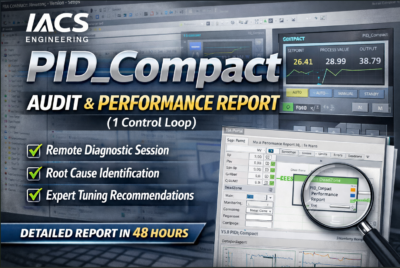
Unstable or poorly tuned PID loops are one of the most common—and most overlooked—sources of inefficiency in industrial plants.
Typical symptoms:
- Oscillating temperature, level, or flow loops
- Slow response impacting production rates
- Constant operator intervention
- Increased energy consumption
- Excessive wear on valves and actuators
👉 In many cases, these issues persist for years—quietly reducing plant performance.
❗ The Reality: Most PID Problems Are Not Tuning Problems
In practice, unstable loops are rarely caused by “bad PID formulas.”
They are caused by:
- Incorrect commissioning methodology
- Improper signal scaling
- Misunderstanding of Siemens PID_Compact behavior
- Hardware limitations (valves, sensors, actuators)
In most cases, PID instability is not a tuning issue—
it is a commissioning and implementation issue.
🧠 Why Siemens PID_Compact Requires Specialized Expertise
PID_Compact is not a generic PID block.
It is a Siemens technology object tightly coupled to the PLC runtime:
- Requires deterministic execution (cyclic interrupt OB)
- Uses internal state management, limits, and signal conditioning
- Includes pretuning and fine tuning algorithms with assumptions
- Interacts directly with HMI, trace, and diagnostics tools
👉 Misunderstanding these details leads to unstable or inconsistent control.
🔄 Version Awareness (Critical but Often Ignored)
Siemens PID_Compact behavior varies across versions:
- V1.x – Basic implementation (early S7-1200)
- V2.x – Industry standard with improved stability and diagnostics
- V3.x – Introduces DeadZone (deadband) and improved modularity
👉 Most plants operate on V2.x or mixed environments, where behavior differences matter.
At IACS Engineering, we evaluate:
- Controller version and firmware
- Compatibility constraints
- Opportunities to improve stability (e.g. DeadZone usage)
👉 Ignoring version differences is a common cause of inconsistent performance
🏭 Where We Add Value
IACS Engineering supports:
✔ Plants with unstable or inefficient control loops
✔ Commissioning teams struggling with PID_Compact
✔ Maintenance teams dealing with recurring oscillations
✔ Facilities where auto-tuning has failed
🔍 Typical Problems We Resolve
Across industrial systems, we regularly diagnose:
- Temperature loops oscillating after commissioning
- Level control instability in tanks and vessels
- Flow loops affected by valve stiction
- PID loops performing worse after auto-tuning
- Inconsistent behavior across similar loops
👉 These are not theoretical problems—they are operational risks.
🧭 Our Methodology (Field-Proven, Not Textbook)
We apply a structured approach used in real plant environments.
1. Process Behavior Identification
We determine the true process dynamics:
- Self-regulating (flow, pressure)
- Integrating (level systems)
- Deadtime-dominant (temperature systems)
👉 This step defines the correct control strategy.
2. Foundation & Configuration Audit
PID_Compact must execute in a cyclic interrupt OB (e.g. OB30)
—not in OB1.
We verify:
- PV scaling (raw → engineering units)
- Output scaling vs actuator
- Control direction
- Signal noise and filtering
👉 A large percentage of “tuning issues” originate here.
3. Manual Mode Validation
Before automatic control:
- Actuator behavior is verified
- Process direction is confirmed
- Saturation and limits are checked
👉 This prevents unstable or unsafe operation.
4. Step Response Analysis
We extract real process characteristics:
- Deadtime
- Process gain
- Time constant
👉 This enables tuning based on measured behavior, not assumptions.
5. Structured Tuning Strategy
Auto-tuning is only reliable under ideal conditions.
Most industrial loops require manual refinement.
We apply tuning aligned with process type:
- Fast loops → responsiveness
- Integrating loops → stability
- Deadtime systems → damping and robustness
6. Advanced Siemens-Specific Optimization
We address deeper control issues:
- Integral windup vs output limits
- Cycle time sensitivity and sampling effects
- Noise amplification in derivative action
- Use of DeadZone (V3) for stability near setpoint
We also apply:
- PT1 filtering (Siemens standard blocks)
- Proper limit handling
- Signal conditioning strategies
📊 Data-Driven Diagnostics
All decisions are based on actual plant data:
- Setpoint / PV / Output trends
- Disturbance response
- Oscillation patterns
👉 If data is not analyzed, tuning is guesswork.
🔧 When PID Alone Is Not Enough
Where required, we implement:
- Cascade control
- Split-range control
- Feedforward compensation
👉 These are standard Siemens control strategies for complex systems.
📈 Before vs After Optimization
Before:
- Oscillation and instability
- Slow response
- Operator intervention
- Inefficient operation
After:
- Stable, predictable control
- Faster response
- Reduced manual intervention
- Improved process consistency
💼 Measurable Business Impact
Optimized control loops typically result in:
- 10–30% faster response times
- Reduced energy consumption
- Lower mechanical stress on equipment
- Improved product quality and consistency
👉 These improvements directly impact operational cost and throughput.
👨🔧 IACS Engineering
We specialize in:
- Siemens PID_Compact commissioning and troubleshooting
- Loop performance optimization
- Diagnosing complex control issues in real plant environments
Our approach is:
- Practical and field-proven
- Focused on root cause—not symptoms
- Based on Siemens-specific expertise